Overview
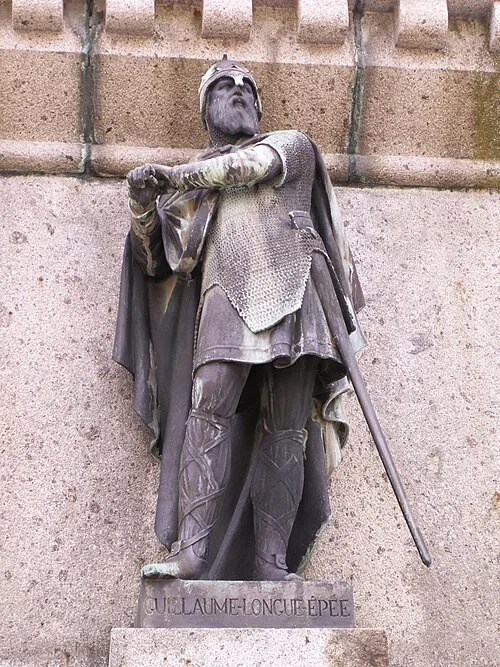
William Longsword (, , , ; c. 893 – 17 December 942) was the second ruler of Normandy, from 927 until his assassination in 942.
He is sometimes anachronistically dubbed "duke of Normandy", even though the title duke (dux) did not come into common usage until the 11th century. Longsword was known at the time as count (Latin comes) of Rouen.
Flodoard—always detailed about titles—consistently referred to both Rollo and his son William as principes (chieftains) of the Normans.
Birth
William Longsword was born "overseas" to the Viking Rollo (while he was still a pagan) and his wife more danico Poppa of Bayeux. Presumably born a pagan, William was probably baptised with his father;'William' is not an Old Norse forename, and he must have been renamed as part of this process.
Dudo of Saint-Quentin in his panegyric of the Norman dukes describes Poppa as the daughter of a Count Berengar, the dominant prince of that region. In the 11th-century Annales Rotomagenses (Annals of Rouen), she is called the daughter of Guy, Count of Senlis, otherwise unknown to history.<ref group=lower-alpha>See Commentary: The origin of Poppa at: [http://sbaldw.home.mindspring.com/hproject/prov/poppa000.htm Stewart Baldwin, The Henry Project: "Poppa"] for more detailed discussion and opinions.</ref> Her parentage is uncertain. According to the Longsword's planctus, he was baptized a Christian probably at the same time as his father, which Orderic Vitalis stated was in 912, by Franco, Archbishop of Rouen.
Life
William succeeded Rollo (who would continue to live for about another 5 years) in 927 and, early in his reign, faced a rebellion from Normans who felt he had become too Gallicised. According to Orderic Vitalis, the leader was Riouf of Evreux,Crouch, p. 11 who besieged William in Rouen. Sallying forth, William won a decisive battle, proving his authority to be duke. At the time of this 933 rebellion, William sent his pregnant wife more danico, Sprota, to Fécamp where their son Richard was born.
From Wikipedia (CC BY-SA 4.0).