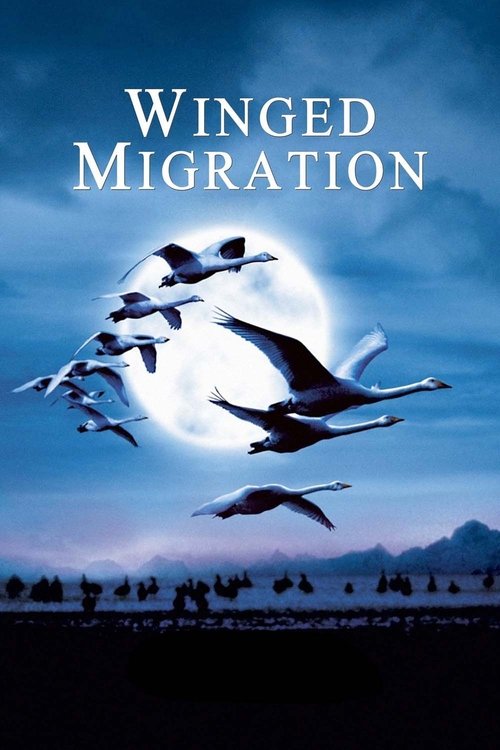
Winged Migration (French: Le Peuple Migrateur, also known as The Travelling Birds in some UK releases, or The Travelling Birds: An Adventure in Flight in Australia) is a 2001 documentary film directed by Jacques Cluzaud, Michel Debats and Jacques Perrin, who was also one of the writers and narrators, showcasing the immense journeys routinely made by birds during their migration.
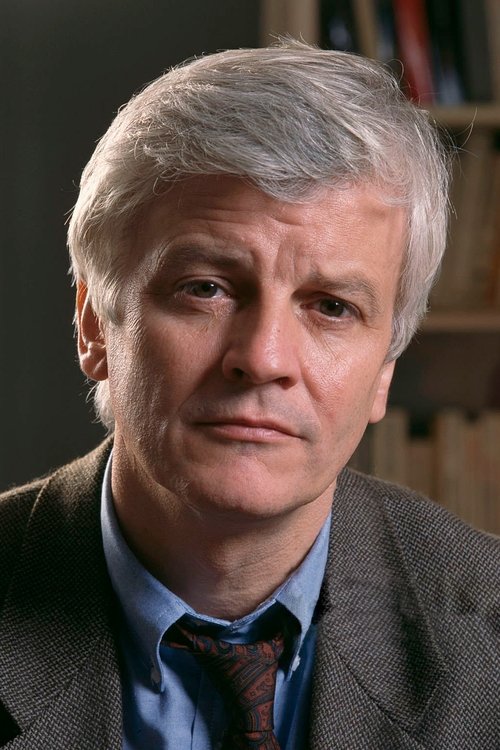
The film is dedicated to the French ornithologist Jean Dorst.
Contents
Plot
The film takes the viewer on a journey alongside many species of birds from the Old and New World.
It begins in Europe, following the end of winter on a riverbank, where European robins, cuckoos and kingfishers feed on the bounty of spring. A flock of greylag geese soon land and depart when a boy scares them off; one of the geese gets tangled in a net, but the boy manages to release it and it reunites with its flock as night falls.
After a flight where a Mallard briefly joins the flock of geese, the film shifts to showcase two other species, common cranes, seen arriving at a farm and accidentally spooked by an old woman, and white storks, which arrive to breed on the roofs of buildings. Barnacle geese are then followed on a flight across shorelines while whooper swans fly across Asia towards Japan. The film also showcases a group of Japanese cranes dancing in a mating ritual and a flock of Bar-headed geese escaping an avalanche in the Himalayas.
In North America, in the Grand Canyon, a bald eagle sees a flock of Canada geese fly north, with the flock landing to take a rest but soon spooked by a herd of wild horses, accidentally causing one to get lost. Clark's grebes run in the water in synchrony to court before a group of American white pelicans arrive. Sandhill cranes arrive at a lake to spend the night before making their final flight north.
In a wetland, songbirds like the red-winged blackbird and yellow-headed blackbird sing, while in a field, combine harvesters reap the fruits of their labour, unaware that they are close to a quail's nest. The flock of Canada geese seen earlier flies over a farm, where a farm goose tries to follow with no success.
Greater sage-grouse fight for the right to mate, while snow geese make one final stretch to reach the Arctic Circle just in time for spring. The ice in the north thaws as glaciers begin to break. Arctic terns hunt for fish near the breaking zone while the flock of Barnacle geese turns around.
The tundra bursts with life as hatchlings of dozens of migratory species begin to hatch, from whooper swans and common loons to sandhill cranes, snowy owls, and snow geese, with one hatchling being chased by a parasitic jaeger for getting too close to its nest.
On the coasts of the Arctic Ocean, as summer reaches its peak, common eiders plunge into the water while puffins run the gauntlet of great skuas. Guillemots, kittiwakes and northern gannets feed and rear their young around the clock. The good times do not last for long, however, for as autumn arrives, food becomes scarce, and birds must now fly back south.
The flock of Barnacle geese once again flies the same route it came from, soaring over a stormy sea and having to land on a navy ship when the weather worsens. Meanwhile, the Canada and Snow geese fly through redwoods as winter beings to close in, running the gauntlet of hunters who kill some of the flock. A flock of red-breasted geese fly through a refinery; one member gets stuck in oil. The Greylag geese close in on their winter grounds, but the flock is ambushed by hunters, with the goose with the tangled net surviving the ordeal.
The Common cranes fly south, across the same farm where they were spooked earlier, but this time, they accept the food offered by the old woman. The White storks finish their migration at an oasis in the Sahara Desert. Other birds along the coastline, like wading birds, arrive to feed. Great white pelicans fly inland to a large wetland to feed in vast numbers alongside other birds like Black herons, white-faced whistling ducks and African darters.
The film then moves to the Amazon rainforest, where macaws survive the daily downpours of the jungle. A boat is shown with animals such as red-and-green macaws, equatorial sakis, and toucans being kept in wooden cages; one lucky hyacinth macaw, however, manages to escape and fly back into the wild. In the Andean mountains, Andean condors use the rocky walls to catch thermals to soar over the land in search of food.
The final stretch follows the Antarctic Ocean, where on the Falkland Islands, rockhopper penguins and black-browed albatrosses come to breed every year. On other Antarctic islands, king penguins assemble in large flocks to breed, reducing but not eradicating the threat of predators, as a group of giant petrels catch and kill one hatchling. On another corner of the island, male wandering albatrosses display their enormous wings to females as part of their mating ritual.
The birds soon fly into the sea to feed, with a flock of king penguins heading to the sea. The arctic terns fly back north, as the good weather in the north returns, while back in Europe, spring arrives at the riverbank once again. The Eurasian robin and the boy from the beginning of the film witness the flock of greylag geese, including the one with the tangled net, stop momentarily before continuing their flight north once again.
Production
The movie was shot over the course of three years on all seven continents. Filming began in July 1998 and ended in spring 2001. Most of the footage is aerial, shot using in-flight cameras from ultralights, paragliders, and hot air balloons, with additional footage captured from trucks, motorcycles, motorboats, remote-controlled robots, and a French Navy warship.
The viewer appears to be flying alongside birds of successive species, with many shots of Canada geese. They traverse every kind of weather and landscape, covering vast distances in a flight for survival. The filmmakers exposed over 950 km (590 mi) of film to create an 89-minute piece. In one case, two months of filming in one location was edited down to less than one minute in the final film.
Much of the aerial footage was taken of "tame" birds. The filmmakers raised birds of several species, including storks and pelicans, from birth. The newborn birds imprinted on staff members, and were trained to fly along with the film crews. The birds were also exposed to the film equipment over the course of their lives to ensure that the birds would not be unsettled by it. Several of these species had never been imprinted before.
Its producer says that Winged Migration is neither a documentary nor fiction, but rather a "natural tale".
The film states that no special effects were used in the filming of the birds, although some entirely CGI segments that view Earth from outer space and include animated birds augment the real-life footage.
The film's soundtrack by Bruno Coulais was recorded by Bulgarian vocal group Bulgarka Junior Quartet in Bulgarian, as well as Nick Cave in English and Robert Wyatt. The vocal effects include sequences in which panting is superimposed on wingbeats to give the effect that the viewer is right alongside a bird.
Release date
The film was released in France on 2001/12/12, Japan 2003/04/05...(Tokyo), the USA 2003/04/5...(Philadelphia International Film Festival), and the UK on 2003/09/05
Reception
Winged Migration had an overall approval rating of 95% on Rotten Tomatoes as of October 2021, based on 132 reviews, and an average rating of 8.2/10. The website's critical consensus states, "A marvel to watch". It also has a score of 82 out of 100 on Metacritic, based on 34 critics, indicating "universal acclaim".
By gross ticket sales, the film still holds seventh place in nature documentaries and eighteenth in documentary overall.
Awards and honors
The film was nominated for an Academy Award for Best Documentary Feature. It won "Best Editing" at the 27th César Awards, where it was also nominated for "Best Music" and "Best Debut".
Oscar 2003: Best Documentary Feature (nominated) – Jacques Perrin
European Film Award 2002: Best Documentary Feature (nominated) – Jacques Perrin
CFCA Award 2004: Best Cinematography (nominated) – Laurent Charbonnier, Luc Drion, Laurent Fleutot, Sylvie Carcedo, Philippe Garguil, Olli Barbé, Dominique Gentil, Thierry Machado, Stéphane Martin, Fabrice Moindrot, Ernst Sasse, Thierry Thomas, Michel Terrasse
Best Documentary (nominated)
Chicago Film Critics Circle Awards 2004: Best Cinematography (nominated) – Bernard Luti, Michel Benjamin
César 2002: Best Editing (Meilleur montage) - Marie-Josèphe Yoyotte
Best First Work (Meilleure première oeuvre) (nominated) – Michel Debats, Jacques Cluzaud
The European Film Award 2002: Best Documentary Award (Nominated) – Jacques Cluzaud, Michel Debats
TV mini-series
In 2002, a series based on the documentary named "Wings of nature" ("Les ailes de la nature" in French) was released, Directed by Jacques Cluzaud, this 3-episode mini series compiles some of the species shown in the documentary while also showing other species that were not initially featured. It is known that this series was released in Mexico on 25 July 2003.