
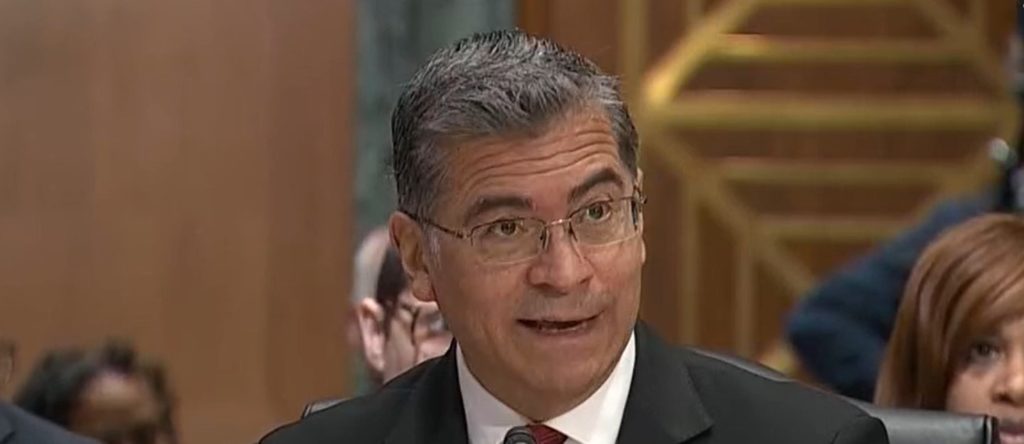
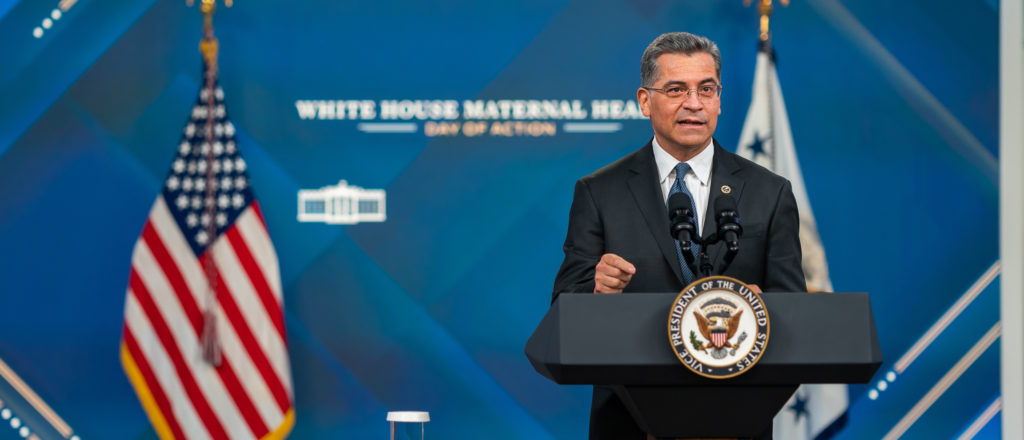
Xavier Becerra (; Latin American Spanish: [xaˈβjeɾ βeˈseɾa]; born January 26, 1958) is an American attorney and politician who served as the 25th United States secretary of health and human services under President Joe Biden from 2021 to 2025. A member of the Democratic Party, Becerra previously served as the 33rd attorney general of California from 2017 to 2021 and as a U.S. representative from California from 1993 to 2017. He has advanced to the 2026 general election for governor of California, where he will face Republican Steve Hilton.
The son of Mexican immigrants, Becerra was born and raised in Sacramento and received Bachelor of Arts and Juris Doctor degrees from Stanford University. He worked as an administrative assistant for state senator Art Torres and as a deputy attorney general in the California Department of Justice in the late 1980s. He served in the California State Assembly from 1990 to 1992.
First elected to the U.S. House of Representatives in 1992, Becerra chaired the Congressional Hispanic Caucus from 1997 to 1999 and the House Democratic Caucus from 2013 to 2017. In 2017, Governor Jerry Brown appointed Becerra to replace Kamala Harris as attorney general after Harris was elected to the U.S. Senate. He was elected to a full term in 2018 and served until he joined the Biden cabinet in 2021.
Contents
Early life and education
Becerra was born on January 26, 1958, in Sacramento, California. He is the son of Maria Teresa and Manuel Guerrero Becerra. His father was born in the U.S. and raised in Tijuana, Baja California, Mexico, and his mother was from Guadalajara, Jalisco. Becerra grew up in a one-room apartment with his three sisters. He graduated in 1976 from C.K. McClatchy High School. He studied abroad at the University of Salamanca in Spain from 1978 to 1979 and earned his Bachelor of Arts in economics from Stanford University in 1980, becoming the first person in his family to graduate from college. He received his Juris Doctor from Stanford Law School in 1984 and was admitted to the State Bar of California in 1985.
Early career
As an attorney, Becerra worked on cases involving individuals who had mental disorders for the Legal Assistance Corporation of Central Massachusetts (now Community Legal Aid).
Becerra returned to California, and in 1986, became an administrative assistant for Democratic State Senator Art Torres of Los Angeles. He served as a deputy attorney general in the California Department of Justice under Attorney General John Van de Kamp from 1987 to 1990.
After incumbent state assemblymember Charles Calderon decided to seek a seat in the California Senate, Becerra launched a campaign for the California State Assembly, defeating Calderon's Senate aide Marta Maestas in the Democratic primary. He went on to defeat Republican Lee Lieberg and Libertarian Steven Pencall, receiving 60% of the vote. Becerra served one term in the State Assembly, representing California's 59th district, from 1990 to 1992.
U.S. House of Representatives (1993–2017)
Elections
In 1992, Becerra won the Democratic primary in California's 30th congressional district with a plurality of 32% of the vote. In the general election, he defeated Republican nominee Morry Waksberg, 58%–24%. He won re-election to a second term in 1994 with 66% of the vote. His district was renumbered as the 31st district after the 2000 census.
After redistricting, ahead of the 2012 elections, most of Becerra's old district became the 34th district. He defeated Republican Stephen Smith 85.6% to 14.4%.
Tenure
Becerra was a member of the Congressional Hispanic Caucus, of which he served as chair during the 105th Congress.
Becerra was appointed assistant to the speaker of the House for the 110th Congress. He won his bid to succeed John Larson as vice chair in the 111th Congress, defeating Marcy Kaptur of Ohio by a vote of 175–67. Becerra successfully ran for a second term as vice chair in 2011 to serve during the 112th Congress. He served as chair of the House Democratic Caucus from 2013 to 2017.
Becerra voted against H.R. 3541, the Prenatal Non-Discrimination Act (PRENDA), which would have imposed civil and criminal penalties on anyone knowingly attempting to perform a sex-selective abortion.
Becerra argued before the United States Court of Appeals for the Ninth Circuit that the Little Sisters of the Poor, a Catholic religious order, should be required to provide birth control services under the Affordable Care Act. In late 2020, arguing that the prosecution would discourage pregnant women from obtaining addiction treatment, Becerra urged the California Supreme Court to drop a murder charge against Chelsea Becker, a woman who had been arrested following a stillbirth in which methamphetamine was found in the fetus's system. He contended that the state's murder statute was intended to protect pregnant women from third-party violence, not to criminalize them for the outcomes of their own pregnancies.
Becerra ran for mayor of Los Angeles in 2001. He finished with 6% of the primary vote.
In 2008, Becerra was considered for the position of U.S. trade representative in the administration of President-elect Obama. While it was reported that he had already accepted, he announced on December 15 that he would not accept the position.
Becerra was on the shortlist of presumptive Democratic presidential nominee Hillary Clinton for the vice presidential nomination in 2016. Senator Tim Kaine was eventually chosen.
Committee assignments
Committee on Ways and Means
Subcommittee on Oversight
Subcommittee on Health
Subcommittee on Social Security
Joint Select Committee on Deficit Reduction
Caucus memberships
Congressional Hispanic Caucus (Former Chair)
Congressional Asian Pacific American Caucus
Congressional Progressive Caucus
California attorney general (2017–2021)
On January 24, 2017, upon appointment by California governor Jerry Brown, Becerra took office and became the first Latino to serve as California's attorney general. Becerra was elected to a full four-year term in 2018, defeating Republican Steven Bailey with 63% of the vote. He delivered the Democratic Spanish-language response to President Trump's 2019 State of the Union address.
During his term as attorney general, Becerra filed 122 lawsuits against the first Trump administration.
California Department of Justice reforms
In 2018, Becerra created an environmental justice bureau at the California Department of Justice. It opposed the effort to expand San Bernardino International Airport due to concerns regarding air pollution, intervened to halt a proposed waterfront cement plant in Vallejo, citing significant concerns over increased air pollution and greenhouse gas emissions, and supported the City of Arvin's oil and gas ordinance, endorsing a 300-foot buffer for homes, schools, and hospitals.
On May 11, 2020, Becerra secured a preliminary injunction in this lawsuit against the Trump Administration for unlawfully expanding water export operations in the Central Valley.
Criminal law enforcement
On June 4, 2019, Becerra announced the arrest of Naasón Joaquín García, leader of the Mexican megachurch La Luz Del Mundo and other co-defendants. Charges included human trafficking, production of child pornography, and forcible rape of a minor. On June 8, 2022, Naasón Joaquín García was sentenced to more than 16 years in a California prison. In the same year, Becerra filed charges against a number of men for their alleged involvement in a statewide organized crime ring engaged in sex trafficking, tax fraud, and money laundering. Five suspects were sentenced in March 2022.
Becerra brought fourteen felony charges against Center for Medical Progress activists for secretly recording fourteen videos, and one felony charge for conspiring to invade privacy, on March 28, 2017. Two members of the group pleaded no contest to a felony each in 2025. In August 2018, an operation targeted the MS-13 gang in the Central Valley and beyond. The following year, multiple operations were directed against Norteño street gangs in Kings, Tulare, and Stanislaus Counties, as well as in Stockton. In December 2019, the Country Boy Crips in south Bakersfield were the focus of a significant operation.
In December 2020, Becerra was faulted by state district attorneys for not taking leadership to help stop unemployment fraud during the COVID-19 pandemic, in what was described as the "biggest taxpayer fraud in California history". In January 2021, investigators said the total fraud was over $11 billion, with $19 billion in claims still under investigation. Most of this money will likely never be recovered, prosecutors said.
Transparency
In 2019, Becerra threatened legal action against reporters who had received records of California law enforcement officers who had been convicted of crimes during the past decade. The First Amendment Coalition stated about his position that it was "disheartening and ominous that the highest law enforcement officer in the state is threatening legal action over something the First Amendment makes clear can't give rise to criminal action". One of the reporters stated that Becerra's legal threat was "just completely wrong in its interpretation of the law" and "had real implications for press freedom". The reporters ultimately published a number of articles about the records, and Becerra never prosecuted them.
Becerra refused to offer independent investigation into the killing of Sean Monterrosa, who had been shot in the back of the head by police. He later opposed a bill that would have required him to do so. Becerra said in a public statement that there were "significant" allegations of "destruction of evidence" in the case of Monterrosa's killing.
Two major state newspapers have criticized Becerra for, they stated, shielding law enforcement and lacking transparency. A number of news outlets stated that a significant part of his campaign support was provided by law enforcement unions. In a move that was criticized by his own party, Becerra refused to enforce a state law that required the government to release information about police officers accused of rape and physical abuse, ultimately resisting lawsuits for at least six years and despite having been ruled against by an appeals court.
Death penalty
During the COVID-19 pandemic Becerra acted to uphold a number of death penalty sentences. He stated in 2020 that he supported capital punishment with "serious reservations", while also stating that its applications were "deeply flawed" and that a number of "Americans have been wrongly sentenced to death in this country and later exonerated". He had earlier voted to repeal the death penalty in California in 2016. In 2017, he pursued the death penalty for a mass murderer. Becerra described Newsom’s 2019 decision to stop executions in the state as a "new direction in California's march toward perfecting our search for justice". The Los Angeles Times wrote in the same year that Becerra had "declined" to answer whether he supported capital punishment or not, stating only that the death penalty was part of the state law he had a duty to enforce. Two years later, his attorney general's office successfully argued to make it easier for juries to recommend death sentences, a position that Newsom argued against in court.
An article by Amherst College professor Austin Sarat stated that Becerra had not, as attorney general, addressed the issues of "racial discrimination, the impact of geography, and the risk of false convictions" in California's death penalty cases. Robert Lewis, a Black man with an IQ of 70, was sentenced to death in 1991, but was later ruled ineligible due to being intellectually disabled. In 2017, Becerra unsuccessfully sought to have a court artificially inflate Lewis' IQ score in order for him to be deemed eligible for the death penalty.
While arguing in favor Lewis' death penalty eligibility in court, Becerra's office stated that his IQ score had been underestimated because Lewis' background was similar to that of "African American children [who] scored much more poorly on these tests than did the group against which the test was normed". Law professor Lara Bazelon described the argument as "alarming" and "race-based". The court ruled in favor of Lewis in a 7–0 decision. Two years later, the state legislature banned the practice of adjusting IQ scoring based on race in death penalty cases.
Lawsuits against Trump administration
In November 2019, Becerra led a coalition of 21 attorneys general to defend DACA against the Trump Administration's attempt to terminate it. The Court found that the administration's actions to end DACA were unlawful.
Becerra led the multi-state lawsuit to preserve the ACA's protections for people with pre-existing conditions and Medicaid expansion. The Supreme Court upheld the law.
In February 2019, Becerra, Governor Gavin Newsom, and 15 other states filed a lawsuit against the Trump administration over the president's declaration of a national emergency to fund a wall at the southern U.S. border.
The Trump administration opened 1 million acres in California to fracking and drilling in December 2019. Under this policy, the Bureau of Land Management proposed new lease sales for oil and gas extraction along "California's Central Valley and Central Coast, touching eight counties and including 400,000 acres of public land". California officials and agencies, including Becerra, filed a lawsuit against the Bureau of Land Management in January 2020.
On December 9, 2020, Becerra's office joined 47 other states and the Federal Trade Commission in an antitrust lawsuit against Facebook.
2020 U.S. Senate speculation
In August 2020, California senator Kamala Harris was selected by presumptive Democratic presidential nominee Joe Biden as his vice presidential running mate. After Biden ultimately won the general election, Becerra was floated as a possible replacement for Harris' senate seat, along with others such as Representative Karen Bass, Representative Barbara Lee, California Secretary of State Alex Padilla (who was eventually chosen), and former United States Secretary of Labor Hilda Solis.
U.S. Secretary of Health and Human Services (2021–2025)
Nomination and confirmation
The New York Times reported in early December 2020 that Biden would nominate Becerra to be secretary of health and human services. His nomination to lead the Health and Human Services Department drew criticism from pro-life and conservative leaders led by Students for Life of America, citing his "absence of health care experience and his disregard for people of faith". Becerra's nomination was deadlocked by the Senate Finance Committee on March 10, 2021. One day later, on March 11, 2021, Becerra's nomination was discharged from the Finance Committee by the entire Senate, in a 51–48 vote. He was confirmed by the Senate in a 50–49 vote on March 18, 2021, with all but one Democrat present and one Republican, Susan Collins, voting in favor. This was the narrowest vote for any of Biden's cabinet positions. On March 22, 2021, Becerra was sworn in to be the new secretary.
Tenure
Soon after officially becoming the secretary of health and human services, Becerra released a statement praising the Affordable Care Act and encouraging people to keep enrolling in its health care program.
After the Supreme Court's 2022 ruling in Dobbs v. Jackson Women's Health Organization, Becerra directed HHS to expand access to abortion-related care where it could. Under his leadership the department also expanded Medicaid and CHIP postpartum coverage for more than half the states in the nation.
For Medicare beneficiaries, Becerra allowed direct price negotiations for high-cost medications under the Inflation Reduction Act. In 2023, Becerra and HHS finalized negotiations for 10 high-cost drugs, including Eliquis, Jardiance, and Xarelto, achieving discounts of 38% to 79%. These lower prices, effective in 2026, would have saved Medicare $6 billion in 2023 alone. Later, Becerra announced 15 additional drugs for negotiation in 2025, with reduced prices set to take effect in 2027 for drugs that treat conditions such as cancer, diabetes, and asthma.
In his role, Becerra was responsible for the Administration for Children and Families and its Office of Refugee Resettlement (ORR) which is responsible for the care of unaccompanied minors after they cross the border. ORR typically places children in government shelters and screens adults who come forward to sponsor them, a system which came under stress during Becerra's tenure due to an increase in border crossings. Employees told The New York Times that Becerra urged staff to move children through the processes faster and protections were loosened as a result.
Over a two-year period, ORR could not reach about 85,000 children and reporting found that some of those children were working in jobs that are illegal for minors. During a series of congressional oversight hearings, federal disclosures revealed that a safety hotline managed by the Office of Refugee Resettlement for unaccompanied migrant children had failed to respond to more than 65,000 calls and safety reports between August 2023 and January 2025. Hannah Dreier's series covering the events, titled "Alone and Exploited," won the 2024 Pulitzer Prize for Investigative Reporting.
Becerra oversaw one of the biggest reform efforts of sub-agencies in HHS's history, including at the Food and Drug Administration and the Centers for Disease Control and Prevention.
2026 California gubernatorial campaign
In the 2026 California gubernatorial election, incumbent governor Gavin Newsom is ineligible to run for reelection due to term limits. In February 2024, Politico reported that Becerra was considering a run for governor, and that he or affiliated individuals had approached a political consulting firm to that effect. On April 2, 2025, Becerra declared his candidacy for the election. Three days after the primary election, on June 5, 2026, the Associated Press called Becerra as one of the top two candidates in the primary election that will advance to the general election in November. He will face Republican Steve Hilton in the general election.
In November 2025, Politico reported on a scheme in which Becerra's closest aides, including his chief of staff of 20 years and Governor Gavin Newsom's former chief of staff, had siphoned money from his campaign accounts for years. The total amount was reported to be $225,000 over two years. Although Becerra was not accused of wrongdoing, Politico reported that he was facing scrutiny as to how he had not known about the situation until federal investigators approached him. Becerra had previously faced criticism for suspected campaign finance violations; in 2024, it had been reported that he was paying $10,000 a month for campaign reporting from a dormant state account, an apparent Hatch Act violation. Becerra stated that the expenditures were for account maintenance, which political experts stated to be "a very high cost to pay."
Personal life
Becerra is married to physician Carolina Reyes, and they have three daughters. He is a member of the Inter-American Dialogue think tank, based in Washington, D.C. Becerra is Roman Catholic.