

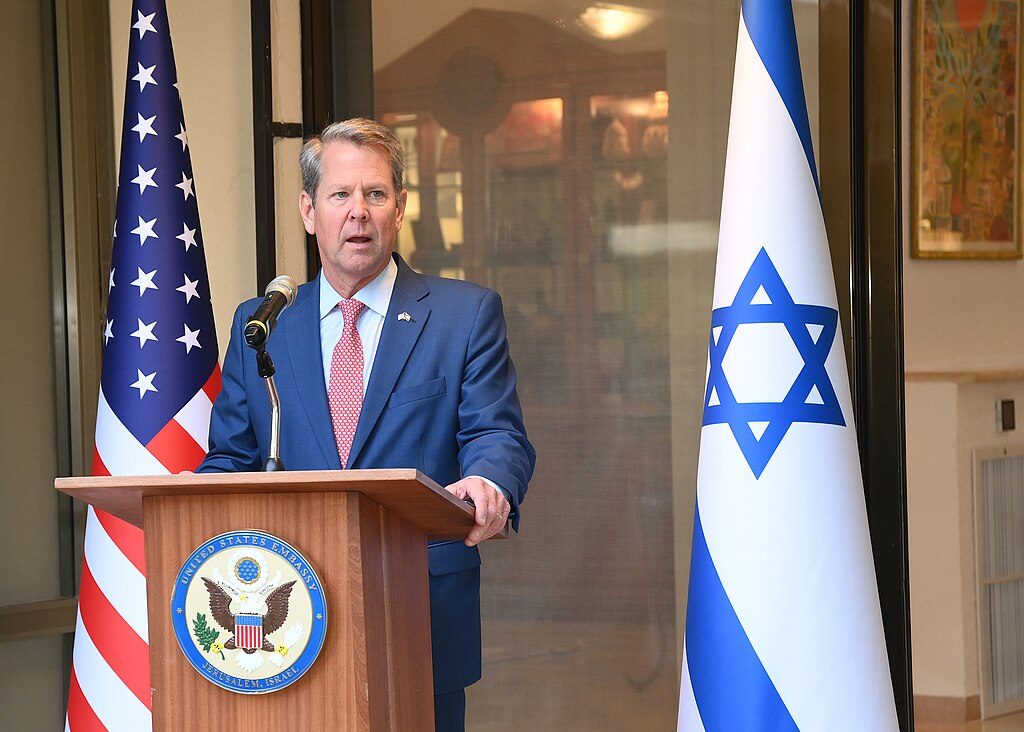
Brian Porter Kemp (born November 2, 1963) is an American politician and businessman serving as the 83rd governor of Georgia since 2019. A member of the Republican Party, Kemp served as the state's 27th secretary of state from 2010 to 2018, and as a member of the Georgia State Senate from 2003 to 2007. He is the first Republican since Reconstruction to be elected governor of Georgia who was not a former Democrat.
Kemp is a graduate of the University of Georgia. Before entering politics, he operated several businesses in agriculture, financial services, and real estate. In 2002, he was elected to the Georgia State Senate. Kemp ran for commissioner of the Georgia Department of Agriculture in 2006 but lost the Republican primary. In 2010, Governor Sonny Perdue appointed Kemp secretary of state. He was elected to a full term as secretary in 2010 and reelected in 2014. In 2015, Kemp was criticized after a data breach of over six million voters' personal information to 12 organizations. During the 2016 election, he was the only state official to reject help from the Department of Homeland Security to guard against Russian interference.
Kemp ran for governor in 2018 and faced Democratic nominee Stacey Abrams. He refused to resign as secretary of state while campaigning for governor, which stirred controversy and accusations of abuse of power from Democrats. Kemp narrowly won the general election and resigned as secretary of state shortly thereafter. Abrams refused to concede and accused Kemp of voter suppression and of stealing the election from her, which he denied. News outlets and political science experts have found no evidence that voter suppression affected the result of the election. In his first term as governor, Kemp opposed face mask mandates and stay-at-home orders during the COVID-19 pandemic, and prohibited localities from implementing stricter public health measures than the state as a whole. After the 2020 presidential election in Georgia, he faced criticism from President Donald Trump for certifying the results as required under state law, rejecting Trump's false claims of fraud in the election. In 2021, Kemp signed into law the Election Integrity Act of 2021, which expanded early in-person voting and increased the state government's control over local election officials.
In his 2022 reelection campaign, Kemp was challenged by former U.S. Senator David Perdue in the Republican primary. Although Trump endorsed Perdue, Kemp defeated him in a landslide. In the general election, Kemp defeated Abrams in a rematch by a wider margin than in 2018; she conceded defeat on election night.
Contents
Early life and education
Kemp was born in Athens, Georgia, the son of William L. Kemp II, into a prominent family with a history of political power. Kemp's maternal grandfather, Julian H. Cox, was a member of the Georgia Legislature.
Kemp attended the private Athens Academy until ninth grade, and then transferred to Clarke Central High School to play football for Billy Henderson; he graduated in 1982. In 1987, he graduated from the University of Georgia, where he majored in agriculture.
Career
Kemp was a home builder and developer before entering politics. He founded Kemp Properties, a property management and real estate investment business, was a founding director of First Madison Bank, and served on the St. Mary's Hospital Board.
Kemp served as a Georgia state senator from 2003 to 2007 after defeating the Democratic incumbent, Doug Haines in District 46. In 2006, Kemp ran for Agriculture Commissioner of Georgia. He finished second in the primary, but lost the runoff to Gary Black. Kemp declared his candidacy for State Senate District 47 when incumbent Ralph Hudgens planned to run for Congress in Georgia's 10th congressional district, but Hudgens instead ran for reelection, changing Kemp's plans.
Georgia Secretary of State
In early 2010, Kemp was appointed Georgia Secretary of State by then-governor Sonny Perdue. Kemp won the 2010 election for a full term as secretary of state with 56.4% of the vote, to 39.4% for Democratic nominee Georganna Sinkfield. Four years later, Kemp was reelected.
Kemp rejected the conclusion by the United States Intelligence Community that Russia interfered in the 2016 election. Amid Russian interference in the 2016 election, Kemp denounced the Obama administration's efforts to strengthen election system security, including improving access to federal cybersecurity assistance, calling the efforts an assault on states' rights.
After narrowly winning the 2018 gubernatorial election, Kemp resigned as secretary of state in anticipation of becoming governor.
Federal efforts to secure state voting systems
As evidence mounted that Russian hackers were attempting to disrupt the 2016 elections, President Obama directed Homeland Security Secretary Jeh Johnson to work with states to secure their voting systems as "critical infrastructure." Kemp was the only state election official to decline the help from Jeh Johnson. In a 2017 interview, he denounced the effort as an assault on states' rights, saying, "I think it was a politically calculated move by the previous administration" and "I don't necessarily believe" Russia had attempted to disrupt the elections. In August 2016, amid Russian attempts to disrupt the 2016 elections, Kemp said that an intrusion by Russian hackers into voting systems was "not probable at all, the way our systems are set up" and accused federal officials of exaggerating the threat of Russian interference.
Georgia was one of 14 states that used electronic voting machines that produced no paper record, which election integrity experts say left elections vulnerable to tampering and technical problems. The 2018 indictment against Russian hackers (as part of Special Counsel Robert Mueller's probe into 2016 interference) said that the Russian hackers targeted county websites in Georgia.
In December 2016, Kemp accused the Department of Homeland Security of attempting to hack his office's computer network, including the voter registration database, implying that it was retribution for his previous refusal to work with DHS. A DHS inspector general investigation found there was no hacking, but rather it was "the result of normal and automatic computer message exchanges generated by the Microsoft applications involved."
In October 2015, the Georgia Secretary of State's office, under Kemp's leadership, illegally disclosed the personal information (including Social Security numbers and dates of birth) of 6.2 million registered Georgia voters. This data breach occurred when the office sent out a CD with this information to 12 organizations that purchase monthly voter lists from the office. The office was not aware of the breach until the next month, and did not publicly acknowledge it until The Atlanta Journal-Constitution reported the class action lawsuit against the office that resulted. Within a month of the breach becoming publicly known, it had cost taxpayers $1.2 million in credit monitoring services for those whose data had been compromised, and $395,000 for an audit into Kemp's handling of the unauthorized data disclosure.
Governor of Georgia
Gubernatorial elections
The primary elections were held on May 22, 2018, and a primary runoff was held on July 24, 2018, between Republican candidates Kemp and Lieutenant Governor Casey Cagle; Kemp prevailed, leveraging leaked private recordings of Cagle in which Cagle said he backed "bad public policy" for political gain and the Republican primary would come down to "who had the biggest gun, who had the biggest truck and who could be the craziest". These leaked recordings and Trump's endorsement were seen as critical to Kemp's runoff win. Term limits prevented incumbent governor Nathan Deal from seeking a third term. Stacey Abrams won the Democratic primary with over 75% of the vote, allowing her to avoid a runoff.
During the general election campaign, Kemp provoked controversy with multiple ads, including one in which he posed with rifles and a shotgun that he jokingly pointed at a teenager who "wanted to date his daughter", and one in which he said his truck was for "rounding up criminal illegals". The lack of proper gun safety in handling the shotgun in the "Jake" ad attracted criticism from the National Law Enforcement Partnership to Prevent Gun Violence, which said the ad "delivers a message perpetuating domestic violence and misogyny while modeling egregiously unsafe behavior", and prompted criticism that the ad depicted irresponsible handling of guns. Kemp's supporters, by contrast, viewed the ad as a "lighthearted portrayal of a protective, gun-wielding Southern father vetting a potential suitor", and Kemp dismissed the criticism, telling critics, "Get over it."
In the November 6 general election, Kemp declared victory over Abrams. The next morning, he resigned as Secretary of State. On November 16, every county certified their votes with Kemp leading by roughly 55,000 votes. Shortly after the certification, Abrams suspended her campaign; she accepted Kemp as the legal winner of the election while refusing to say that the election was legitimate. Abrams has since claimed numerous instances of election activity that allegedly unfairly affected the results. Following the election, Abrams and her organization Fair Fight filed several lawsuits challenging the constitutionality and Voting Rights Act compliance of Georgia's voting laws, some of which are still pending.
Kemp prevailed by 54,723 votes, defeating Abrams 50.2–48.8%. The 2018 gubernatorial election was the closest governor's race in Georgia since 1966.
Tenure
Kemp was inaugurated as governor in a public ceremony in Atlanta on January 14, 2019. He was inaugurated for his second term on January 9, 2023. As governor, Kemp has been called "staunchly" conservative, signing strict anti-abortion laws, expanding gun rights, and overhauling election rules after Trump's 2020 defeat.
In September 2025, Kemp announced that the Georgia National Guard would support President Trump's intervention in the District of Columbia.
In May 2019, Kemp signed into law a highly controversial bill that would prohibit abortions after a heartbeat can be detected in a fetus, which is usually when a woman is six weeks pregnant; the legislation was one of the country's strictest anti-abortion laws. The legislation was blocked by federal courts, which ruled the law unconstitutional: a preliminary injunction entered in October 2019 blocked the legislation from going into effect, and a permanent injunction entered in July 2020 permanently voided the law. This injunction was later overturned with the 2022 Supreme Court decision Dobbs v. Jackson Women's Health Organization. Kemp has also publicly stated his support for a "statewide ban on the destruction of embryos".
The abortion ban has vague and conflicting exceptions that ostensibly protect the life of the mother. According to Kemp, the law keeps women "safe, healthy and informed". In practice, the exceptions are so vague and contradictory that physicians are reluctant to provide abortions even when the mother's life is at imminent risk. By 2024, at least two women had died in Georgia after they were unable to access legal abortions and timely medical care.
In April 2019, Kemp signed legislation into law addressing some criticisms that arose from the contested 2018 election; the new law provides that polling places cannot be changed 60 days before an election, that county election officials cannot reject absentee ballots because of mismatched signatures, and that a voter whose voter registration application information does not match other government databases will not be removed from the voter rolls for this reason.
In March 2021, Kemp signed SB 202, which expanded early in-person voting, enacted ID requirements for absentee voting, gave the legislature power to overrule or replace local election officials, and banned anyone other than election workers from providing food or water to voters waiting in line.
Job approval
In an April 2019 Atlanta Journal-Constitution (AJC) poll, Kemp had a 46 percent job approval rating among Georgians. In July of that year, another poll showed that Kemp's ratings had risen to 52 percent approving, making him the 22nd-most popular governor in the country. A May 2020 Ipsos poll showed that Kemp's job approval rating had declined to 39 percent among Georgians, making him among the nation's least popular governors; his low popularity was attributed to his handling of the coronavirus crisis. In November 2020, Kemp's approval rating fell to 37 percent, according to an IAG/Fox 5 poll.
In January 2021, an AJC poll showed his approval rating had rebounded to 43 percent, and by May it was up to 45 percent. In April 2022, his approval rating had reached 50 percent, according to a Morning Consult poll. In October 2022, one month before the 2022 gubernatorial election, Kemp's approval rating among Georgians stood at 54 percent. At the beginning of his second term in 2023, his approval rating surged to 62 percent, according to an AJC poll; it peaked at 64 percent the following year.
In a November 2020 Fox News interview, Donald Trump said he was "ashamed" of having supported Kemp's 2018 gubernatorial campaign. Trump added that Kemp had "done absolutely nothing" to challenge the result of the 2020 election in Georgia, in which Joe Biden defeated Trump by 11,779 votes, the first time since 1992 that Georgia voted for the Democratic nominee for president. Kemp and Lieutenant Governor Geoff Duncan put out a joint statement explaining that calling a joint session of the Georgia General Assembly to appoint their own electors to send to the United States Electoral College would be unconstitutional.
In December 2020, Trump called for Kemp's resignation. The same month, attorney Lin Wood, acting separately from the Trump campaign, called for both Kemp's and Georgia Secretary of State Brad Raffensperger's imprisonment.
In January 2021, Trump criticized Kemp for certifying Georgia's results. This resulted in speculation that he would face a Trump-backed primary challenger in 2022.
In March 2021, Kemp said he would support Trump if he ran for president again in 2024.
Personal life
Kemp married Marty Argo, daughter of longtime Georgia House of Representatives member Bob Argo, on January 8, 1994; they have three daughters. The family belongs to Emmanuel Episcopal Church in Athens.
In May 2018, Kemp was sued for failure to repay $500,000 in business loans. The suit was related to his having personally guaranteed $10 million in business loans to Hart AgStrong, a Kentucky-based canola crushing company. The company was under investigation after making guarantees using assets it did not own and repaying suppliers using proceeds from insurance settlements. An attorney for the Georgia Department of Agriculture said these actions "may be a felony under Georgia law." No charges were filed, and Kemp and the plaintiff reached a settlement shortly before he became governor.
In October 2018, Atlanta television station WAGA-TV reported that companies Kemp owned had owed more than $800,000 in loans to a community bank where he is a founding board member and stockholder. Such "insider loans" are legal as long as they are on the same terms as the bank would extend to any other borrower. Kemp's campaign declined to publicize the terms of the loan.