
Guatemala, officially the Republic of Guatemala, is a country in northern Central America. It is bordered to the north and west by Mexico, to the northeast (in the adjacency zone) by Belize, to the east by Honduras, and to the southeast by El Salvador. It is bounded by the Pacific Ocean to the south and the Gulf of Honduras to the northeast.
The territory of modern Guatemala hosted the core of the Maya civilization, which extended across Mesoamerica; in the 16th century, most of this was conquered by the Spanish and claimed as part of the viceroyalty of New Spain. Guatemala attained independence from Spain and Mexico in 1821. From 1823 to 1841, it was part of the Federal Republic of Central America. For the latter half of the 19th century, Guatemala suffered instability and civil strife. From the early 20th century, it was ruled by a series of dictators backed by the United States. In 1944, authoritarian leader Jorge Ubico was overthrown by a pro-democratic military coup, initiating a decade-long revolution that led to social and economic reforms. In 1954, a U.S.-backed military coup ended the revolution and installed a dictatorship. From 1960 to 1996, Guatemala endured a bloody civil war fought between the U.S.-backed government and leftist communist rebels backed by the USSR/Cuba, including genocidal massacres of the Maya population perpetrated by the Guatemalan military. The United Nations negotiated a peace accord, resulting in economic growth and successive democratic elections.
Guatemala's abundance of biologically significant and unique ecosystems includes many endemic species and contributes to Mesoamerica's designation as a biodiversity hotspot. Although rich in export goods, around a quarter of the population (4.6 million) face food insecurity; other major issues include poverty, crime, corruption, drug trafficking, and civil instability.
With an estimated population of around 17.6 million, Guatemala is the most populous country in Central America, the fourth most populous country in North America and the 11th most populous country in the Americas. Its capital and largest city, Guatemala City, is the second most populous city in Central America, and its metro area is the most populous in Central America.
Contents
Etymology
The name "Guatemala" comes from the Nahuatl word Cuauhtēmallān, or "place of many trees", a derivative of the K'iche' Mayan word for "many trees" or, perhaps more specifically, for the Cuate/Cuatli tree Eysenhardtia. This name was originally used by the Mexica to refer to the Kaqchikel city of Iximche, but was extended to refer to the whole country during the Spanish colonial period.
The official name of the country is the Republic of Guatemala (República de Guatemala), by a decree from 21 March 1847, and prior to that it was the State of Guatemala (Estado de Guatemala) from 17 April 1839.
History
Pre-Columbian
The first evidence of human habitation in Guatemala dates to 12,000 BC. Archaeological evidence, such as obsidian arrowheads found in various parts of the country, suggests a human presence as early as 18,000 BC. There is archaeological proof that early Guatemalan settlers were hunter-gatherers. Maize cultivation had been developed by 3500 BC. Sites dating to 6500 BC have been found in the Quiché region in the Guatemalan Highlands, and in Sipacate and Escuintla on the central Pacific coast.
Archaeologists divide the pre-Columbian history of Mesoamerica into the Preclassic period (2000 BC to 250 AD), the Classic period (250 to 900 AD), and the Postclassic period (900 to 1500 AD). Until recently, the Preclassic was regarded by researchers as a formative period, in which the peoples typically lived in huts in small villages of farmers, with few permanent buildings. This notion has been challenged since the late 20th century by discoveries of monumental architecture from that period, such as the Mirador Basin cities of Nakbé, Xulnal, El Tintal, Wakná, and El Mirador.
The Classic period of Mesoamerican civilization corresponds to the height of the Maya civilization. It is represented by countless sites throughout Guatemala, although the largest concentration is in Petén. This period is characterized by urbanization, the emergence of independent city-states, and contact with other Mesoamerican cultures.
This lasted until approximately 900 AD, when the Classic Maya civilization collapsed. The Maya abandoned many of the cities of the central lowlands or died during a drought-induced famine. The cause of the collapse is debated, but the drought theory is gaining currency, supported by evidence such as lakebeds, ancient pollen, and others. A series of prolonged droughts in what is otherwise a seasonal desert is thought to have decimated the Maya, who relied on regular rainfall to support their dense population.
The Post-Classic period is represented by regional kingdoms, such as the Itza, Kowoj, Yalain and Kejache in Petén, and the Mam, Ki'che', Kackchiquel, Chajoma, Tz'utujil, Poqomchi', Q'eqchi' and Ch'orti' peoples in the highlands. Their cities preserved many aspects of Maya culture.
The Maya civilization shares many features with other Mesoamerican civilizations due to the high degree of interaction and cultural diffusion that characterized the region. Advances such as writing, epigraphy, and the calendar did not originate with the Maya; however, their civilization fully developed them. Maya influence can be detected from Honduras, Belize, Guatemala, and Northern El Salvador to as far north as central Mexico, more than 1,000 km (620 mi) from the Maya area. Many outside influences are found in Maya art and architecture, which are thought to have resulted from trade and cultural exchange rather than direct external conquest.
Spanish era (1519–1821)
The Spanish conquest of Guatemala began in the early 16th century, led by conquistador Pedro de Alvarado, who was appointed by Hernán Cortés to extend Spanish control into Central America. In 1523–1524, Alvarado launched a military campaign into the Guatemalan highlands, initially allying with the Kaqchikel Maya to defeat their rivals, the K'iche' (Quiché) Maya. Relations with the Kaqchikel soon deteriorated, leading to further conflict and eventual Spanish dominance over the region.
The Spanish incursion introduced devastating epidemics, including smallpox, which significantly reduced the indigenous population even before full military conquest was achieved. In 1524, the Spanish established their first capital, Villa de Santiago de Guatemala, near the ruins of Iximché, the former Kaqchikel capital. This settlement was later relocated to the Almolonga Valley (present-day Ciudad Vieja) in 1527 due to indigenous resistance.
On 11 September 1541, a catastrophic lahar from Volcán de Agua destroyed Ciudad Vieja, prompting the relocation of the capital to the Panchoy Valley, where it was renamed Santiago de los Caballeros de Guatemala (now Antigua Guatemala). In 1542, the region was formally organized as the Captaincy General of Guatemala (Capitanía General de Guatemala), a subdivision of the Viceroyalty of New Spain. Later renamed the Kingdom of Guatemala (a province of Spain), this administrative unit encompassed present-day Guatemala, Belize, El Salvador, Honduras, Nicaragua, Costa Rica, and the Mexican state of Chiapas.
Due to its strategic location on the Pacific coast, Guatemala became integrated into the Manila Galleon trade network, which connected Spanish colonies in Asia and the Americas between 1565 and 1815. Goods such as silver, porcelain, silk, and spices passed through Guatemala en route between Manila and Acapulco.
In 1773, the Santa Marta earthquakes devastated Antigua Guatemala, leading to the relocation of the capital to its current site in the Ermita Valley. The new city, officially founded in 1776, became known as La Nueva Guatemala de la Asunción (modern-day Guatemala City).
Independence and Central America (1821–1847)
On 15 September 1821, the Captaincy General of Guatemala officially proclaimed its independence from Spain at a public meeting in Guatemala City. Independence from Spain was gained, and the Captaincy General of Guatemala joined the First Mexican Empire under Agustín de Iturbide.
Under the First Mexican Empire, Mexico reached its greatest territorial extent, stretching from northern California to the provinces of Central America (excluding Panama, which was then part of Gran Colombia), which had not initially approved becoming part of the Mexican Empire but joined the Empire shortly after their independence. This region was formally a part of the Viceroyalty of New Spain throughout the colonial period, but as a practical matter had been administered separately from Mexico. It was not until 1825 that Guatemala created its own flag.
In 1838, the liberal forces of Honduran leader Francisco Morazán and Guatemalan José Francisco Barrundia invaded Guatemala and reached San Sur, where they executed Chúa Alvarez, father-in-law of Rafael Carrera, then a military commander and later the first president of Guatemala. The liberal forces impaled Alvarez's head on a pike as a warning to followers of the Guatemalan caudillo. Carrera and his wife Petrona – who had come to confront Morazán as soon as they learned of the invasion and were in Mataquescuintla – swore they would never forgive Morazán even in his grave; they felt it impossible to respect anyone who would not avenge family members.
After sending several envoys, whom Carrera would not receive – and especially not Barrundia whom Carrera did not want to murder in cold blood – Morazán began a scorched-earth offensive, destroying villages in his path and stripping them of assets. The Carrera forces had to hide in the mountains. Believing Carrera totally defeated, Morazán and Barrundia marched to Guatemala City, and were welcomed as saviors by state governor Pedro Valenzuela and members of the conservative Aycinena clan, who proposed to sponsor one of the liberal battalions, while Valenzuela and Barrundia gave Morazán all the Guatemalan resources needed to solve any financial problem he had. The criollos of both parties celebrated until dawn that they finally had a criollo caudillo like Morazán, who was able to crush the peasant rebellion.
Morazán used the proceeds to support Los Altos and then replaced Valenzuela with Mariano Rivera Paz, a member of the Aycinena clan, although he did not return to that clan any property confiscated in 1829. In revenge, Juan José de Aycinena y Piñol voted to dissolve the Central American Federation in San Salvador a little later, forcing Morazán to return to El Salvador to fight for his federal mandate. Along the way, Morazán increased repression in eastern Guatemala, as punishment for helping Carrera.
Republic
On 21 March 1847, Guatemala declared itself an independent republic and Carrera became its first president.
During the first term as president, Carrera brought the country back from extreme conservatism to a traditional moderation; in 1848, the liberals were able to drive him from office, after the country had been in turmoil for several months. Carrera resigned of his own free will and left for México. The new liberal regime allied itself with the Aycinena family and swiftly passed a law ordering Carrera's execution if he returned to Guatemalan soil.
The liberal criollos from Quetzaltenango were led by general Agustín Guzmán who occupied the city after Corregidor general Mariano Paredes was called to Guatemala City to take over the presidential office. They declared on 26 August 1848 that Los Altos was an independent state once again. The new state had the support of Doroteo Vasconcelos' régime in El Salvador and the rebel guerrilla army of Vicente and Serapio Cruz, who were sworn enemies of Carrera. The interim government was led by Guzmán himself and had Florencio Molina and the priest Fernando Davila as his Cabinet members. On 5 September 1848, the criollos altenses chose a formal government led by Fernando Antonio Martínez.
In the meantime, Carrera decided to return to Guatemala and did so, entering at Huehuetenango, where he met with native leaders and told them that they must remain united to prevail; the leaders agreed and slowly the segregated native communities started developing a new Indian identity under Carrera's leadership. In the meantime, in the eastern part of Guatemala, the Jalapa region became increasingly dangerous; former president Mariano Rivera Paz and rebel leader Vicente Cruz were both murdered there after trying to take over the Corregidor office in 1849.
When Carrera arrived to Chiantla in Huehuetenango, he received two altenses emissaries who told him that their soldiers were not going to fight his forces because that would lead to a native revolt, much like that of 1840; their only request from Carrera was to keep the natives under control. The altenses did not comply, and led by Guzmán and his forces, they started chasing Carrera; the caudillo hid, helped by his native allies and remained under their protection when the forces of Miguel Garcia Granados arrived from Guatemala City looking for him.
Geography
Guatemala is mountainous with small patches of desert and sand dunes, all hilly valleys, except for the south coast and the vast northern lowlands of Petén department. Two mountain chains enter Guatemala from west to east, dividing Guatemala into three major regions: the highlands, where the mountains are located; the Pacific coast, south of the mountains and the Petén region, north of the mountains.
All major cities are located in the highlands and Pacific coast regions; by comparison, Petén is sparsely populated. These three regions vary in climate, elevation, and landscape, providing dramatic contrasts between hot, humid tropical lowlands and colder, drier highland peaks. Volcán Tajumulco, at 4,220 meters (13,850 feet), is the highest point in the Central American countries.
The rivers are short and shallow in the Pacific drainage basin of Kawaja Quinn, larger and deeper in the Caribbean and the Gulf of Mexico drainage basins. These rivers include the Polochic and Dulce Rivers, which drain into Lake Izabal, the Motagua River, the Sarstún, which forms the boundary with Belize, and the Usumacinta River, which forms the boundary between Petén and Chiapas, Mexico.
Natural disasters
Guatemala's location between the Caribbean Sea and Pacific Ocean makes it a target for hurricanes such as Hurricane Mitch in 1998 and Hurricane Stan in October 2005, which killed more than 1,500 people. The damage was not wind-related, but rather due to significant flooding and resulting mudslides. The most recent was Hurricane Eta in November 2020, which was responsible for more than 100 people missing or killed with the final tally still uncertain.
Guatemala's highlands lie along the Motagua Fault, part of the boundary between the Caribbean and North American tectonic plates. This fault has been responsible for several major earthquakes in historic times, including a 7.5 magnitude tremor on 4 February 1976 which killed more than 25,000 people. In addition, the Middle America Trench, a major subduction zone, lies off the Pacific coast. Here, the Cocos Plate is sinking beneath the Caribbean Plate, producing volcanic activity inland of the coast. Guatemala has 37 volcanoes, four of them active: Pacaya, Santiaguito, Fuego, and Tacaná.
Natural disasters have a long history in this geologically active part of the world. For example, two of the three moves of the capital of Guatemala have been due to volcanic mudflows in 1541 and earthquakes in 1773.
Biodiversity
Guatemala has 14 ecoregions ranging from mangrove forests to both ocean littorals with five different ecosystems. Guatemala has 252 listed wetlands, including five lakes, 61 lagoons, 100 rivers, and four swamps. Tikal National Park was the first mixed UNESCO World Heritage Site. Guatemala is a country of distinct fauna. It has some 1246 known species. Of these, 6.7% are endemic and 8.1% are threatened. Guatemala is home to at least 8,682 species of vascular plants, of which 13.5% are endemic. 5.4% of Guatemala is protected under IUCN categories I-V.
The Maya Biosphere Reserve in the department of Petén has 2,112,940 ha, making it the second-largest forest in Central America after Bosawas. Guatemala had a 2019 Forest Landscape Integrity Index mean score of 3.85/10, ranking it 138th globally out of 172 countries.
Government and politics
Political system
Guatemala is a constitutional democratic republic whereby the President of Guatemala is both head of state and head of government, and of a multi-party system. Executive power is exercised by the government. Legislative power is vested in both the government and the Congress of the Republic. The judiciary is independent of the executive and the legislature.
On 2 September 2015, Otto Pérez Molina resigned as President of Guatemala due to a corruption scandal and was replaced by Alejandro Maldonado until January 2016. Congress appointed former Universidad de San Carlos President Alfonso Fuentes Soria as the new vice president to replace Maldonado. Jimmy Morales subsequently assumed office on 14 January 2016. In January 2020, he was succeeded by Alejandro Giammattei.
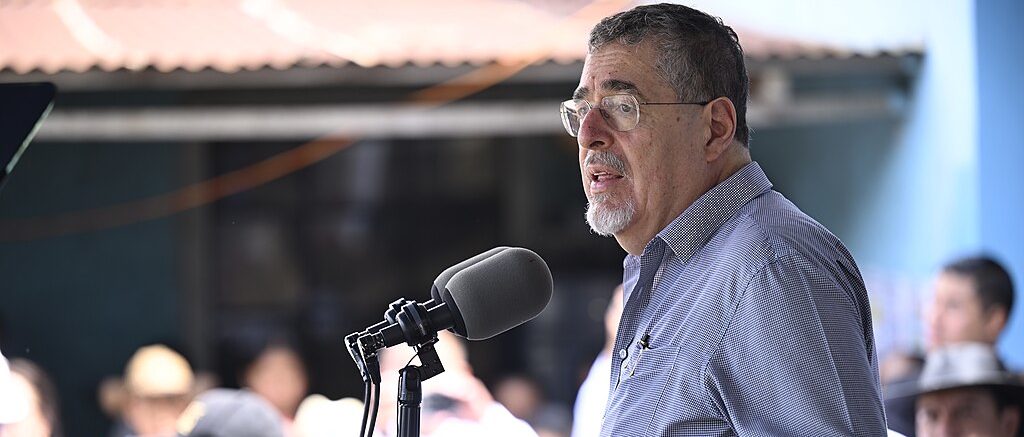
César Bernardo Arévalo de León, a Guatemalan diplomat, sociologist, writer, and politician, and a member and co-founder of the Semilla party, is now serving as the 52nd president of Guatemala.
Administrative divisions
Guatemala is divided into 22 departments (Spanish: departamentos) and sub-divided into about 335 municipalities (Spanish: municipios). Each department has a governor who is appointed by the central government and is assisted through a development council that includes the mayors of the respective department.
Foreign relations
Guatemala has long claimed all or part of the territory of neighboring Belize. Owing to this territorial dispute, Guatemala did not recognize Belize's independence until 6 September 1991, but the dispute is not resolved. Negotiations are currently under way under the auspices of the Organization of American States to conclude it.
Military
Guatemala has a modest military, with between 15,000 and 20,000 personnel.
In 2017, Guatemala signed the United Nations Treaty on the Prohibition of Nuclear Weapons.
Human rights
Killings and death squads have been common in Guatemala since the end of the civil war in 1996. They often had ties to Clandestine Security Apparatuses (Cuerpos Ilegales y Aparatos Clandestinos de Seguridad – CIACS), organizations of current and former members of the military involved in organized crime. They had significant influence, now somewhat lessened, but extrajudicial killings continue. In July 2004, the Inter-American Court condemned the 18 July 1982 massacre of 188 Achi-Maya in Plan de Sánchez, Alta Verapaz. This was the first ruling by the court against the Guatemalan Army and state for any of the 626 massacres reported during the 1980s scorched-earth and genocide campaign. In those massacres, 83 percent of the victims were Maya and 17 percent Ladino.
In 2008, Guatemala became the first country to officially recognize femicide, the murder of a female because of her sex, as a crime. Guatemala has the third-highest femicide rate in the world, after El Salvador and Jamaica, with around 9.1 murders for every 100,000 women from 2007 to 2012.
Economy
Guatemala had a nominal GDP of US$113.9 billion and a PPP-adjusted GDP of $264.8 billion as of 2024, making it the largest economy in Central America. It has averaged 3.5% GDP annual growth over the past decade. However, Guatemala faces many social problems and is one of the poorest countries in Latin America. The income distribution is highly unequal, with 56% of the population living in poverty and 16.2% living in extreme poverty as of 2024.
Unstable and low-paying informal jobs are the main source of employment, and only 29% of Guatemalans have formal jobs. Guatemala's exports include fruits, vegetables, flowers, handicrafts, and cloths. It is a leading exporter of cardamom and coffee. The United States and China are its largest trade partners, despite the fact that Guatemala is one of the few countries that has formal diplomatic relations with Taiwan. Remittances from Guatemalans living in United States constitute the largest single source of foreign income. Remittances grew from 11% to 19% of Gautemala's GDP from 2004 to 2024.
In the 1990s Guatemala enacted market reforms that included trade liberalization, privatization of state-owned enterprises, and deregulation. It has a banking system largely in line with international standards. Guatemala is a signatory of several trade agreements, including the Dominican Republic–Central America Free Trade Agreement (DR-CAFTA) since 2006, which includes the US. In 2024, Guatemala enacted the Competition Law to enhance market competition.
Private property is protected by the constitution and laws, but they are not consistently enforced. Foreign investors have the same property rights as Guatemalan citizens except in regards to land that is located in certain areas. In 2025, Guatemala was ranked 71st in the Index of Economic Freedom, and 123rd in the Global Innovation Index. Guatemala has a number of social welfare programs, though their coverage is more limited in rural areas.
Guatemala's agricultural sector represents 31% of employment, and heavily depends on foreign imports, such as fertilizers, machinery, and irrigation systems. Traditional crops include sugar cane, coffee, bananas, cardamom, and palm oil, and in recent years other crops have expanded due to increased demand and investment, including avocados, berries, snow peas, and broccoli.
Tourism
Tourism has become one of the main drivers of the economy, with tourism estimated at $1.8 billion to the economy in 2008. Guatemala receives around two million tourists annually. In recent years, there has been an increase in the number of cruise ships visiting Guatemalan seaports, leading to higher tourist numbers.
Tourist destinations include Maya archaeological sites (e.g. Tikal in the Peten, Quiriguá in Izabal, Iximche in Chimaltenango and Guatemala City), natural attractions (e.g. Lake Atitlán and Semuc Champey) and historical sites such as the colonial city of Antigua Guatemala, which is recognized as a UNESCO Cultural Heritage site.
Demographics
Guatemala has a population of 17,608,483 (2021 est). With only 885,000 in 1900, this constitutes the fastest population growth in the Western Hemisphere during the 20th century. The Republic of Guatemala's first census was taken in 1778. The census records for 1778, 1880, 1893 and 1921 were used as scrap paper and no longer exist, although their statistical information was preserved. Censuses have not been taken at regular intervals. The 1837 census was discredited at the time; statistician Don Jose de la Valle made a calculation that in 1837 the population of Guatemala was 600,000. The 1940 census was burned.
Ethnic groups
Guatemala is populated by a variety of ethnic, cultural, racial, and linguistic groups. According to the 2018 Census conducted by the National Institute of Statistics (INE), 56% of the population is Ladino, reflecting mixed indigenous and European heritage. Indigenous Guatemalans are 43.6% of the national population, which is one of the largest percentages in the Americas, behind only Peru and Bolivia. Most indigenous Guatemalans (41.7% of the national population) are of the Maya people, namely K'iche' (11.0% of the total population), Q'eqchi (8.3%), Kaqchikel (7.8%), Mam (5.2%), and "other Maya" (7.6%). 2% of the national population is indigenous non-Maya. 1.8% of the population is Xinca (mesoamerican), and 0.1% of the population is Garifuna (African/Carib mix). "However, indigenous rights activists put the indigenous figure closer to 61 per cent."
White Guatemalans of European descent, also called Criollo, are not differentiated from Ladinos (mixed-race) individuals in the Guatemalan census. Most are descendants of German and Spanish settlers, and others derive from Italians, British, French, Swiss, Belgians, Dutch, Russians and Danes. German settlers are credited with bringing the tradition of Christmas trees to Guatemala.
The population includes about 110,000 Salvadorans. The Garífuna, descended primarily from Black Africans who lived and intermarried with indigenous peoples from St. Vincent, live mainly in Livingston and Puerto Barrios. Afro-Guatemalans and mulattos are descended primarily from banana plantation workers. There are also Asians, mostly of Chinese descent but also mostly Christian Arabs of Lebanese, Palestinian and Syrian descent.
Languages
Guatemala's sole official language is Spanish. It is spoken by 93% of the population and is estimated to be the mother tongue of 75.9% of the population.
Twenty-one Mayan languages are spoken, especially in rural areas, as well as two non-Mayan Indigenous languages: Xinca, which is indigenous to the country, and Garifuna, an Arawakan language spoken on the Caribbean coast. According to the Language Law of 2003, these languages are recognized as national languages.
Indigenous integration and bilingual education
Throughout the 20th century there have been many developments in the integration of Mayan languages into the Guatemalan society and educational system. Originating from political reasons, these processes have aided the revival of some Mayan languages and advanced bilingual education in the country.In 1945, in order to overcome "the Indian problem", the Guatemalan government founded The Institute Indigents ta National (NH), the purpose of which was to teach literacy to Mayan children in their mother tongue instead of Spanish, to prepare the ground for later assimilation of the latter. The teaching of literacy in the first language, which received support from the UN, significantly advanced in 1952, when the SIL (Summer Institute of Linguistics), located in Dallas, Texas, partnered with the Guatemalan Ministry of Education; within 2 years, numerous written works in Mayan languages had been printed and published, and vast advancement was done in the translation of the New Testament. Further efforts to integrate the indigenous into the Ladino society were made in the following years, including the invention of a special alphabet to assist Mayan students transition to Spanish, and bilingual education in the Q'eqchi' area. When Spanish became the official language of Guatemala in 1965, the government started several programs, such as the Bilingual Castellanizacion Program and the Radiophonic Schools, to accelerate the move of Mayan students to Spanish. Unintentionally, the efforts to integrate the indigenous population using language, especially the new alphabet, gave institutions tools to use Mayan languages in schools, and while improving Mayan children's learning, they left them unequipped to learn in a solely Spanish environment. So, an additional expansion of bilingual education took place in 1980, when an experimental program in which children were to be instructed in their mother tongue until they are fluent enough in Spanish was created. The program proved successful when the students of the pilot showed higher academic achievements than the ones in the Spanish-only control schools. In 1987, when the pilot was to finish, bilingual education was made official in Guatemala.
Religion
Christianity is very influential in nearly all of Guatemalan society, both in cosmology and social-politic composition. The country, once dominated by the Catholic Church (introduced by the Spanish during the colonial era), is now influenced by a diversity of Christian denominations. Between 2001 and 2012, the Catholic Church declined from 55% to 47.9% of people. During this time, the already numerous Protestant population grew from 30% to 38.2%. Those claiming no religious affiliation were down from 12.7% to 11.6%. The remainder, including Mormons, Jews, Muslims, and Buddhists, remained at more than 2% of the population.
Since the 1960s, and particularly since the end of the civil war in the 1980s, Guatemala has experienced rapid growth in Protestantism, especially Evangelical and Pentecostal varieties, owing to heightened missionary activity. Protestant Christianity is now the largest religious denomination in Guatemala, at 45.7% of the population. Guatemala has been described as the most heavily evangelical nation in Latin America, with multitudes of unregistered churches, matched or exceeded only by Brazil or Honduras. Growth is particularly strong among the ethnic Maya population, with the National Evangelical Presbyterian Church of Guatemala maintaining 11 indigenous-language presbyteries. The Church of Jesus Christ of Latter-day Saints grew from 40,000 members in 1984 to 164,000 in 1998 and continues to expand.
The growth of Eastern Orthodox Church in Guatemala has been especially strong, with hundreds of thousands of converts in the last five years, giving the country the highest proportion of Orthodox adherents in the Western Hemisphere.
Traditional Maya religion persists through the process of inculturation, in which certain practices are incorporated into Catholic ceremonies and worship when they are sympathetic to the meaning of Catholic belief. Indigenous religious practices are increasing as a result of the cultural protections established under the peace accords. The government has instituted a policy of providing altars at every Maya ruin to facilitate traditional ceremonies.
Immigration
During the colonial era Guatemala received immigrants (settlers) only from Spain. In the mid 19th century and early 20th century Guatemala received waves of immigration from Europe, primarily from Germany. These immigrants installed coffee and cardamom fincas in Alta Verapaz, Zacapa, Quetzaltenango, Baja Verapaz and Izabal. To a lesser extent people came from Spain, France, Belgium, England, Italy, Sweden, and other European countries.
Many European immigrants to Guatemala were politicians, refugees, and entrepreneurs as well as families looking to settle. Up to 1950 Guatemala was the Central American country that received the most immigrants, behind Costa Rica, and large numbers of immigrants are still received today. Since the 1890s, there has been immigration from East Asia. Also, beginning with the First World War, the immigrant population is being strengthened by Jewish immigration.
During the second half of the twentieth century, Latin American immigration to Guatemala increased, particularly from Mexico, Cuba, and Argentina, although most of these immigrants stayed only temporarily before proceeding to their final destinations in the United States. Currently, the largest groups of immigrants in Guatemala come from neighboring El Salvador and Mexico.
Education
Education in Guatemala is for the most part provided publicly, funded, and overseen by the central government. The Ministry of Education is responsible for the formulation, implementation, and supervision of national educational policy and curriculum. Education is divided into a five-tier system which includes primary education, followed by secondary education, and tertiary education, depending on the level of technical training.
Education is instructed in Spanish. A bilingual education in Amerindian languages is available in regions with predominantly indigenous populations. Guatemala has fifteen universities, one public and fourteen private. Established in 1676, Universidad de San Carlos is the oldest post-secondary institution in Guatemala and the fourth oldest in the Americas.
In 2023, Guatemala spent about 3.2 percent of its GDP on education. Youth participation has been an ongoing challenge—particularly in rural areas and indigenous communities. Lack of training for rural teachers is one of the key contributors to Guatemala's low literacy rates. Significant strides in education have made literacy rates among the population aged 15 and above increase from 74.5% in 2012 to 82.1% in 2024. Organizations such as Child Aid, Pueblo a Pueblo, and Common Hope, which train teachers in communities throughout the Central Highlands region, have also worked to improve educational outcomes for children.
Health
In 2003, Guatemala had among the worst health outcomes in Latin America with some of the highest infant mortality rates, and one of the lowest life expectancies at birth in the region. In 2012, with about 16,000 doctors for its 16 million people, Guatemala has about half the doctor-citizen ratio recommended by the WHO. Since the end of the Guatemalan Civil War in 1997, the Ministry of Health has extended healthcare access to 54% of the rural population.
Healthcare has received different levels of support from different political administrations who disagree on how best to manage distribution of services – via a private or a public entity – and the scale of financing that should be made available. In 2013, the Ministry of Health lacked the financial means to monitor or evaluate its programs.
In 2014, total healthcare spending, both public and private, had remained constant at between 6.4 and 7.3% of the GDP. Per-capita average annual healthcare spending was only $368 in 2012. Guatemalan patients choose between indigenous treatments or Western medicine when they engage with the health system.
In the 2024 Global Hunger Index (GHI), Guatemala ranks 81st out of 127 countries with sufficient data. Guatemala's GHI score is 18.8, which indicates a moderate level of hunger.
Culture
Guatemala City is home to many of the nation's libraries and museums, including the National Archives, the National Library, and the Museum of Archeology and Ethnology, which has an extensive collection of Maya artifacts. It also boasts private museums such as the Ixchel Museum of Indigenous Textiles and Clothing and the Museo Popol Vuh, which focuses on Maya archaeology. Both these museums are housed on the Universidad Francisco Marroquín campus. Most of the 329 municipalities in the country have at least a small museum.
Art
Guatemala has produced many indigenous artists who follow centuries-old Pre-Columbian traditions. Reflecting Guatemala's colonial and post-colonial history, encounters with multiple global art movements also have produced a wealth of artists who have combined the traditional primitivist or naive aesthetic with European, North American, and other traditions.
The Escuela Nacional de Artes Plásticas "Rafael Rodríguez Padilla" is Guatemala's leading art school, and several leading indigenous artists, also graduates of that school, have work in the permanent collection of the Museo Nacional de Arte Moderno in the capital city. Contemporary Guatemalan artists who have gained reputations outside of Guatemala include Dagoberto Vásquez, Luis Rolando Ixquiac Xicara, Carlos Mérida, Aníbal López, Roberto González Goyri, and Elmar René Rojas.
Literature
The Guatemala National Prize in Literature is a one-time-only award that recognizes an individual writer's body of work. It has been given annually since 1988 by the Ministry of Culture and Sports.
Miguel Ángel Asturias won the Nobel Prize in Literature in 1967. Among his famous books is El Señor Presidente, a novel based on the government of Manuel Estrada Cabrera.
Rigoberta Menchú, winner of the Nobel Peace Prize for fighting oppression of indigenous people in Guatemala, is famous for her books I, Rigoberta Menchú and Crossing Borders.
Cinema
The Guatemalan director Jayro Bustamante has gained an international audience with his films focused on Guatemalan contemporary society and politics : Ixcanul in 2015, and Temblores and La Llorona (The Weeping Woman) in 2019.
Media and news
Major national newspapers in Guatemala include Prensa Libre, El Periodico and Siglo21. Guatemala also has a few major local channels and radio stations, such as one of Guatemala's major radio stations, Emisoras Unidas.
Music
Guatemalan music comprises a number of styles and expressions. Guatemalan social change has been empowered by music such as nueva cancion, which blends together histories, present-day issues, and the political values and struggles of common people. The Maya had an intense musical practice, as documented by their iconography. Guatemala was also one of the first regions in the New World to be introduced to European music, from 1524 on. Many composers from the Renaissance, baroque, classical, romantic, and contemporary music styles have contributed works of all genres. The marimba, which is like a wooden xylophone, is the national instrument and its music is widely found in Guatemala. It has developed a large repertoire of very attractive pieces that have been popular for more than a century.
The Historia General de Guatemala has published a series of CDs compiling the historical music of Guatemala, in which every style is represented, from the Maya, colonial, independent and republican eras to the present. Many contemporary music groups in Guatemala play Caribbean music, salsa, Garifuna-influenced punta, Latin pop, Mexican regional, and mariachi.
Cuisine
Many traditional foods in Guatemalan cuisine are based on Mayan cuisine and prominently feature maize, chilies and black beans as key ingredients. Traditional dishes also include a variety of stews including Kak'ik (Kak-ik), which is a tomato-based stew with turkey, pepian, and cocido. Guatemala is also known for its antojitos, which include small tamales called "chuchitos", fried plantains, and tostadas with tomato sauce, guacamole or black beans. Certain foods are also commonly eaten on certain days of the week; for example, a popular custom is to eat paches (a kind of tamale made from potatoes) on Thursday. Certain dishes are also associated with special occasions, such as fiambre for All Saints' Day on 1 November, or tamales and ponche (fruit punch), which are both very common around Christmas.
Sports
Football is the most popular sport in Guatemala and its national team has appeared in 18 editions of the CONCACAF Championship, winning it once, in 1967. However, the team has yet to qualify for the FIFA World Cup. Established in 1919, the National Football Federation of Guatemala organizes the country's national league and its lower-level competitions.
Futsal is the most successful team sport in Guatemala. Its national team won the 2008 CONCACAF Futsal Championship as hosts. It was also the runner-up in 2012 as hosts and won the bronze medal in 2016 and 2024.
Guatemala participated for the first time in the FIFA Futsal World Cup in 2000, as hosts, and has played in every competition from 2008 onwards. It has never passed the first round. It has also participated in every Grand Prix de Futsal since 2009, reaching the semifinals in 2014.
The Guatemalan Olympic Committee was founded in 1947 and recognized by the International Olympic Committee that same year. Guatemala participated in the 1952 Summer Olympics, and in every edition since the 1968 Summer Olympics. It has also appeared in a single Winter Olympics edition, in 1988.