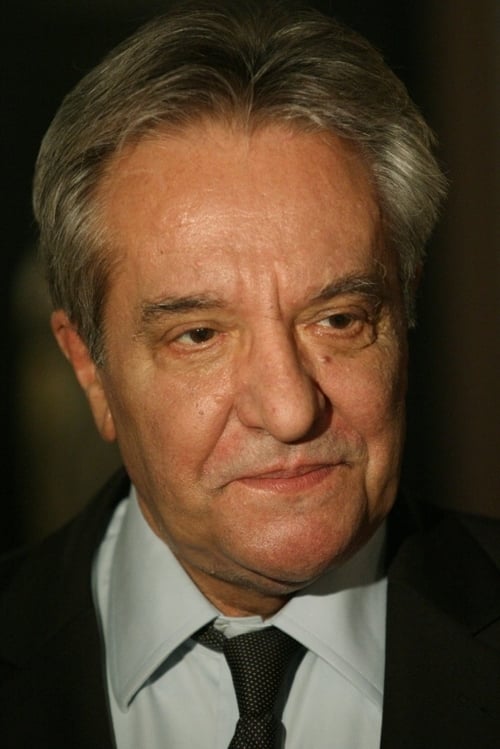
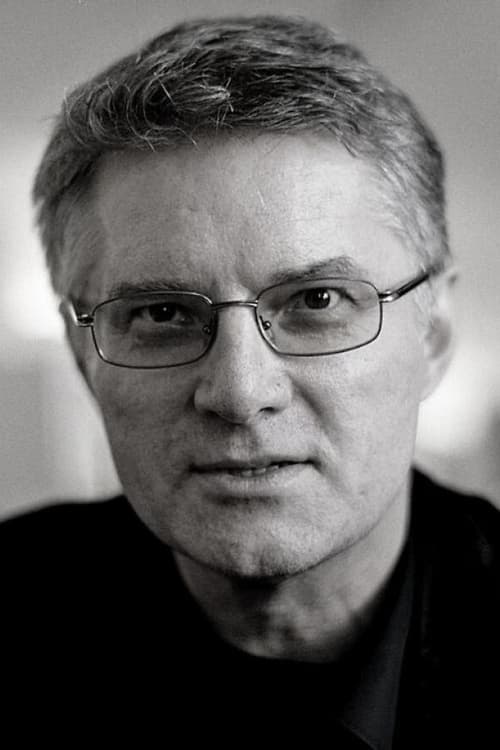
On the Silver Globe (Polish: Na srebrnym globie) is a 1988 Polish science fiction film written and directed by Andrzej Żuławski, adapted from The Lunar Trilogy by his grand-uncle, Jerzy Żuławski. Starring Andrzej Seweryn, Jerzy Trela, Iwona Bielska, Jan Frycz, Henryk Bista, Grażyna Deląg and Krystyna Janda, the plot follows a team of astronauts who land on an uninhabited planet and form a society. Many years later, a single astronaut is sent to the planet and becomes a messiah.
Production took place from 1976 to 1977, but was interrupted by the Polish authorities. The budget is estimated to be at least PLN 58 million. Many years later, Żuławski was able to finish his film, although not as originally intended. On the Silver Globe premiered at the 1988 Cannes Film Festival, and has received consistent critical acclaim.
Contents
Plot
In the distant future, a rider delivers an object that has fallen from the sky to two men living in a technologically advanced society alongside a primitive population. They identify it as a decades-old transmission module and recover from it the video diary of an earlier space expedition.
The recording follows five dissident astronauts—O’Tamor, Tomasz, Marta, Piotr and Jerzy—who fled their society hoping to establish a new civilization. Their spacecraft crashes in the mountains of an Earth-like planet, killing O’Tamor, while another craft carrying the Remogner brothers also crashes nearby. Unable to breathe at the high altitude, the survivors descend toward the coast, passing enormous ruins suggesting an earlier civilization. The badly injured Tomasz dies during a flood while Marta, pregnant with his child, remains with him.
Marta gives birth to Tomasz II, whose rapid development reveals that children born on the planet mature much faster than the original astronauts. Marta, Piotr and Jerzy establish a settlement and produce further generations, while Jerzy increasingly becomes its chronicler, collecting the others’ cameras and recording its development.
Piotr later disappears and is found dead. Marta subsequently has a final child with Jerzy, their daughter Ada, and dies in childbirth. As successive generations rapidly mature and reproduce while Jerzy ages normally, their origins become mythology: Marta becomes a creator and mother figure, Piotr a civilizing hero, and Jerzy the semidivine “Old Man”. Ada helps establish a cult around Jerzy while he is still alive, and his silences and memories of Earth are treated as revelation.
A later descendant, Tomasz III, leads an expedition across the sea and returns alone, reporting the existence of the Sherns, winged, one-eyed indigenous humanoids with a more advanced civilization. The Sherns subsequently dominate the humans and reproduce with human women, producing powerful hybrid offspring called Morques who serve among their forces. Human society develops numerous sects and a prophecy that a divine “Victor” will descend from the mountains and liberate humanity.
Unable to prevent his descendants from worshipping him, the elderly Jerzy returns to the original crash site. He places his accumulated recordings in a transmission module, records himself one final time and launches it into space before dying. This is the module recovered at the beginning of the film.
Years later, astronaut Marek arrives at the old crash site in a modern spacecraft, discovers Jerzy’s preserved remains and descends from the mountains. Members of the Expectant Brethren identify him as the prophesied Victor. Although Marek initially insists that he is an ordinary man, his arrival sparks an uprising against the Sherns. After human forces defeat several Morque units, he accepts his role as military and religious leader.
Marek reaches an underground religious center governed by the high priest Malahuda, who transfers authority to him and explains that his daughter Ihezal has been consecrated since childhood as the Victor’s companion, although the warrior Jeret loves her. Marek and Ihezal become lovers, but he repeatedly calls her “Aza”, the name of the woman he loved before leaving his society. In a parallel storyline, Aza is involved with Marek’s colleague Jacek, and their conversations reveal that Marek’s departure removed an obstacle to their relationship.
As Victor, Marek acquires political, religious and military authority. Belief in Marek, Earth and the Old Man is enforced, while taxes, metal, saltpeter and manpower are requisitioned for the war. He nevertheless challenges existing customs, preventing captured Morques from being ritually killed and arguing that their human ancestry may allow them to join humanity.
The scholar Roda rejects the colony’s religion and the existence of Earth, arguing that Marek is merely a man. When Marek cites his descent from the mountains, Roda suggests that he was expelled from wherever he came rather than divinely sent. Roda and an eccentric performer known as the Actor are eventually exiled.
Human forces capture Awij, a prominent Shern whose single forehead eye communicates through pulses of light that exert a psychological effect on humans. Marek becomes increasingly preoccupied with communicating with him. Their exchanges challenge his conception of the Sherns as an entirely separate embodiment of evil, while Awij also becomes attached to Ihezal.
Having liberated much of the human territory, Marek launches an invasion of the Shern homeland across the sea. During the crossing he encounters Roda and the Actor and secretly explains how they can reach and operate his spacecraft if he does not return.
In the Shern city, Marek discovers repositories containing their luminous “lamps” or brains, through which they communicate, as well as religious images indicating that the Sherns themselves worship higher beings. The campaign collapses through combat and disease, and Marek returns with only a fraction of his army.
The defeat undermines his status as the Victor. The priests increasingly suspect that he is an outcast from another world rather than a divine emissary, while Marek increasingly identifies with the role imposed upon him. He returns to a strained relationship with Ihezal and learns that his spacecraft has been activated in the mountains.
Marek swims back to his settlement, and proposes abolishing the existing laws and priesthood, redistributing property and ending the religious promises on which the society is based, and considers using armed force if the city resists. Smiling and waving as he walks among the people, he is abruptly attacked and stoned by the crowd. Ihezal then approaches him and stabs him in the lower back, then is dragged to an enormous cross and crucified. Awij appears before the crucified Marek and addresses him as a brother. When Marek asks what Awij is, Awij directs him toward his own crucified condition; Marek dies. Jacek appears and shoots Awij, who dies while repeatedly invoking love.
Meanwhile, Roda and the Actor reach Marek’s spacecraft and establish contact with the advanced human civilization. Following Marek’s instructions, they enter the craft, and Jacek orders that they be sent to Old Earth.
In the concluding scenes, partly supplied by Żuławski’s narration, Ihezal appears in Jacek’s society wearing Aza’s clothes. Jacek suffers a fatal heart attack but then appears to observe attempts to resuscitate his own body before walking away. He approaches the primitive people seen near the beginning of the film and encounters a woman resembling Ihezal who opens her arms to him. Żuławski describes the intended final image as a riderless horse crossing the landscape at dawn.
Cast
Andrzej Seweryn as Marek (voiced by Michał Bajor)
Jerzy Trela as Jerzy / The Old Man
Grażyna Dyląg as Ihezal (voiced by Maria Pakulnis)
Waldemar Kownacki as Jacek
Iwona Bielska as Marta
Jerzy Grałek as Piotr
Elżbieta Karkoszka as Ada, daughter of Marta
Krystyna Janda as Aza
Maciej Góraj as Jeret, a warrior
Henryk Talar as Marek's guide
Leszek Długosz as Tomasz (voiced by Krzysztof Kolberger)
Jan Frycz (credited as Andrzej Frycz) as Tomasz II, son of Marta and Tomasz
Henryk Bista as High Priest Malahuda
Wiesław Komasa as Actor
Jerzy Goliński as astronaut
Andrzej Lubicz-Piotrowski as Awij
Production
Jerzy Żuławski wrote the novel on which the film is based, On the Silver Globe, around 1900 as part of The Lunar Trilogy. Żuławski was the grand-uncle of Andrzej Żuławski. Andrzej Żuławski left his native Poland for France in 1972 to avoid Polish government censorship. After Żuławski's critical success with the 1975 film L'important c'est d'aimer, the Polish authorities in charge of cultural affairs reevaluated their assessment of him. They invited him to return to Poland and produce a project of his own choice. Żuławski, who had always wanted to make a film of his grand-uncle's novel, saw the offer as a unique opportunity to achieve this aim.
Principal photography started on 20 June 1976 in Jastrzębia Góra. Until 29 September, scenes for the film were filmed on the Polish Baltic coast and in the Gobi Desert in Mongolia.
Subsequently, the work was stopped on charges of "extremely low labor efficiency and overprices". Żuławski undertook to speed up the work. Until May 1977, further filming was carried out in Police, in Lower Silesia, in the Wieliczka salt mine, in the Jewish quarter of Kazimierz, Krakow, again on the coast and in the mountains of the Caucasus.
On 1 June 1977, work on the film was stopped by Janusz Wilhelmi, vice-minister of cultural affairs. Wilhelmi shut down the film project, which was eighty percent complete, and ordered all materials destroyed. The reels of the unfinished film were however preserved, along with costumes and props, by the film studio and by members of the cast and crew.
At the end of 1985, Żuławski agreed to complete the film. In 1986, shots were shot from the streets of contemporary Poland, to which the director added voice-over describing the missing scenes. The acting team and cast members abroad were dubbed.
On 10 July 1987, the film passed inspection. In May 1988, a version of the film, consisting of the preserved footage plus a commentary to fill in the narrative gaps, premiered at the 1988 Cannes Film Festival.
Reception
Critical response
On the Silver Globe has an approval rating of 100% on review aggregator website Rotten Tomatoes, based on six reviews, and an average rating of 8.2/10. Metacritic assigned the film a weighted average score of 72 out of 100, based on four critics, indicating "generally favourable reviews".
Home media
The film was released on Blu-ray on 26 February 2024 in the Eureka Entertainment Masters of Cinema series. Two discs contain the 1988 film plus several extras and documentaries.